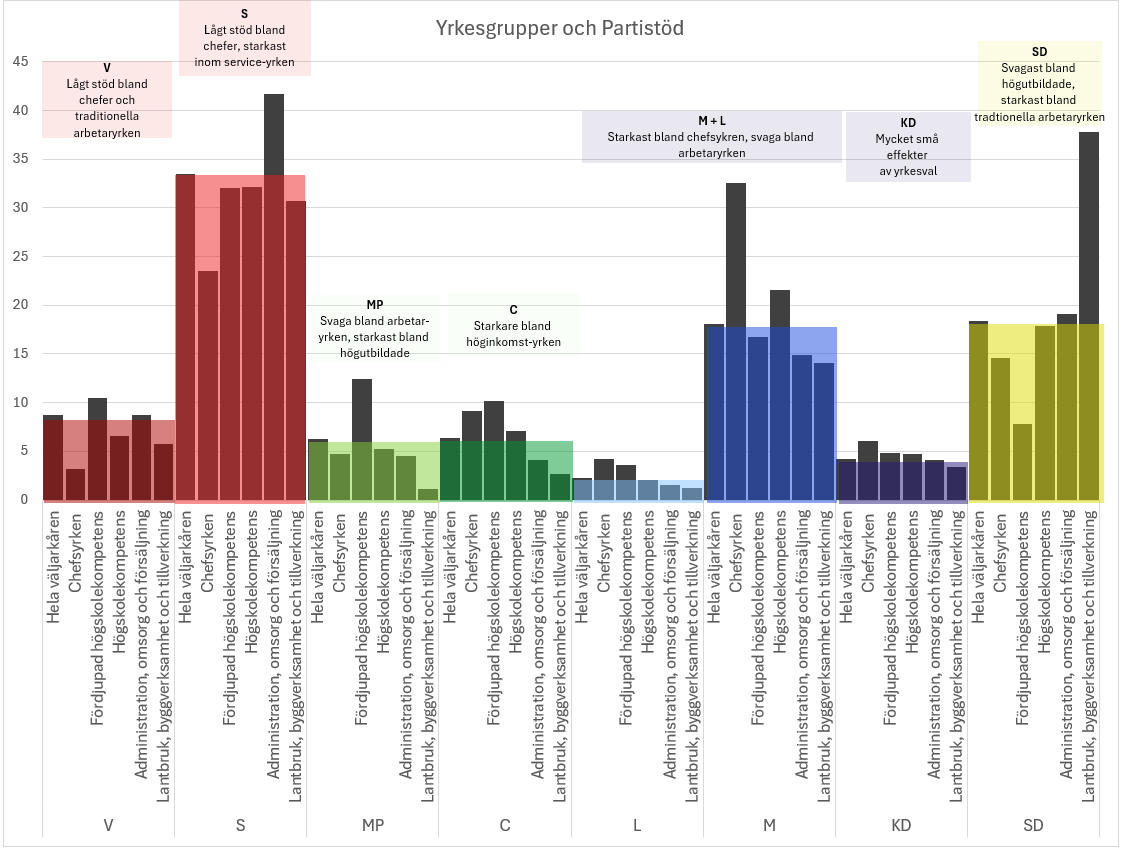
Occupation and Party Preference

    We have looked at the impact that occupation has on party sympathy. What stands out most is how over-represented traditional working-class occupations are among SD sympathisers, and how under-represented their support is among the group ”Occupations requiring a university education or equivalent”. MP has a mirror-image support base: occupations requiring higher education vote for MP to a much greater extent, while support from traditional working-class occupations is minimal. People in managerial jobs are heavily over-represented among the Moderaterna and the Liberalerna, but both service and industrial occupations are far more weakly represented among their voter base. The picture is very similar for C. On the left, it is managerial occupations that stand out by their absence, while service occupations are what lift S and occupations requiring higher education are what lift V. KD is the party least affected by occupational group, even though managers and highly educated people are over-represented there. The file can be found here: ValAnalys26_260817


By |2026-10-31T12:14:31+00:002026-10-01|Uncategorized|0 Comments

Education and Voter Support

Quite a lot has changed when it comes to education and party preference. For M, education no longer has any major effect. S has won back many educated voters, but still fails to attract the very highest educated. Mp, C and L show a clear upward trend in support with level of education, while SD has the opposite effect.   ValAnalys26_260617  

By |2026-10-31T12:14:24+00:002026-10-01|Uncategorized|0 Comments

Election 26: Urban and Rural Areas Drifting Apart

We managed to trick the Election Authority into giving us the preliminary election result as a data file. It is a rather frightening development: we are voting more and more differently in urban and rural areas. In the first image I show the percentage majority for one bloc or the other per municipality. In Norrland, however, people vote even further left, even though the towns are smaller. If we look at the change since the previous election, we see that the right is advancing there too, even though it does not win many municipalities yet. An interesting development, though, is in Skåne, where a local left-wing wave seems to be under way. We also see that all the big cities vote further left than before. However, it is not land or municipalities that vote, but people, so I also show the majority for one bloc or the other in number of votes. valdistrikt-hela-landet-2026_LL260918_3

By |2026-10-31T12:14:11+00:002026-10-01|Uncategorized|0 Comments

State Deficit in Citizen Kronor

The state budget deficit has increased markedly; here is a comparison between expenditure in 2022 and 2026. Increased defence costs are of course the largest item, but rising costs for the justice system also add to the deficit. By citizen kronor we mean total expenditure divided by the number of citizens.   StatsbudgetWorking__LL260306_Ext

By |2026-10-31T12:14:08+00:002026-10-01|Uncategorized|0 Comments

Variable interest rates falling again

The variable interest rate is usually lower, because if you want to lock in your rate, you normally have to pay a kind of insurance premium for it. If the variable rate is higher, on the other hand, something has usually happened that is disrupting the market, e.g. a financial crisis, a pandemic or a large-scale war. I have illustrated these periods in red. Now, however, we can see the variable rate heading back towards its normal state, which I have marked in green. Is this a light at the end of the tunnel?   finansmarknadsstatistik-fm5001-svensk_2025-10-27 (1)

By |2026-10-31T12:14:06+00:002026-10-01|Uncategorized|0 Comments
Go to Top